

Redistricting Unfairness Started in Democrat Controlled New York, Not Texas
At present, Spanberger is explaining too much -- which means Virginia Democrats are losing the argument.


The problem isn’t Republican states, but Democratic states where unfairness has prevailed for so long that Democrats cannot recognize the word fair anymore.
Tension between Virginia Governor Abigail Spanberger and the renegades in the Democratic-controlled General Assembly is flaring up yet again, only this time it isn’t taxing data centers to death but taxing Virginia’s patience:
With less than one month to go, nearly a dozen Democratic state lawmakers, strategists and candidates say Spanberger — Virginia’s popular Democratic governor who cruised to victory by double-digits last November — needs to step up more assertively to sell the referendum to voters. And they’re warning that she’ll bear the brunt of the blame if the effort fails.
It’s not that she’s doing nothing: Spanberger has endorsed the referendum and launched an ad supporting it this week, her first of the campaign, as POLITICO first reported. But critics say it’s the bare minimum for an effort that is supposed to be a top Democratic priority as the party works to counter GOP-led states that are redrawing their own maps.
Of course, this shibboleth of blame shifting — Republicans did it first, Democrats are responding — just isn’t playing out for the precise reason that it just ain’t true.
If the question around redistricting is who is playing with the lines, or more precisely whether playing with the lines is a reaction to bad form on the opposite side, then the answer — and indeed, the blame — lies with New York Democrats, whose effort to gerrymander their congressional seats so as to remove a lone Republican in Staten Island was blocked by the U.S. Supreme Court this March.
So much for who threw the first punch.
Beyer: Unfair In Virginia; Totally Fair for America?
Then we get into the unfairness-for-fairness-sake argumentation from Virginia Democrats, who argue that such extremes are “temporary” in the face of other extremes, that democracy can be interrupted for democracy’s sake pace Scott Surovell, and that — in the words of Rep. Don Beyer (D-VA):
“It’s not a done deal by any means,” said Rep. Don Beyer, D-Va. “We have to effectively make the case that even though this seems unfair in Virginia, it’s totally fair for America, for those of us who believe that taking back the House is the most significant thing we can do to stop Donald Trump.”
The problem isn’t in Republican states, but in Democratic states where unfairness has prevailed so long that Democrats cannot recognize the word fair anymore. To wit, this is one of many examples of what Democrats call fairness:
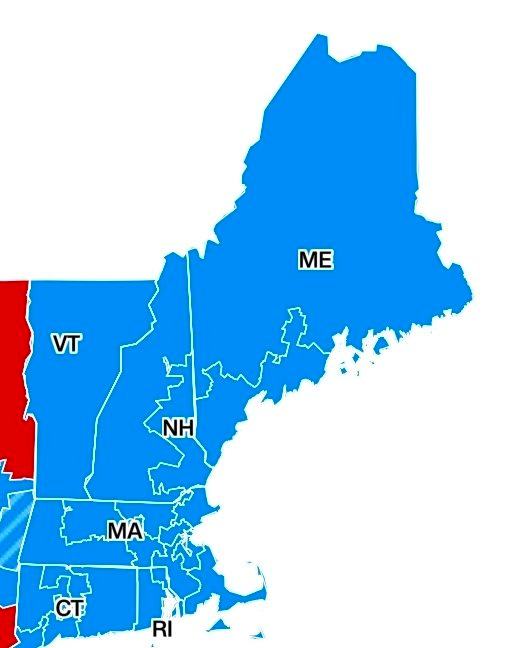
40% of Connecticut votes Republican. Does anyone see proportionality or fairness in Connecticut? Move forward to other states such as Maryland and Illinois, whose gerrymandered seats in Democratic strongholds are literally chokepoints designed to crush non-Democratic voices.
Then there’s the text of the actual amendment, a patently unconstitutional phrasing which the Virginia Supreme Court in what could only be termed as a profile in cowardice by punting on any ruling until after the April vote.
Restoring fairness? Only in the New England definition of the term.
Monoculture from people who preach diversity aside, the real purpose of the amendment is plain for anyone to see. It would almost be refreshing if Democrats were simply honest about their aims.
Yet Virginia Democrats have more to worry about than bringing sporks to a knife fight (good line, Beth Macy). If the special election in Virginia Beach is any indicator, the April referendum might say redistricting, but it is quickly becoming a lack of confidence vote in Virginia Democrats.
No Budget Yet — But Plenty of Time to Campaign for Redistricting?
Meanwhile, the cognoscenti in Richmond seem to have passed over unnoticed and unmentioned that at present, we do not have a state budget.
That’s right — the Democrats sent everyone home without having passed a state budget, a condition actively placing every locality in limbo as they have to set their budgets not knowing how Richmond will reciprocate and collective bargaining on the horizon should Spanberger sign the legislation in to law — on top of over $6 billion in state tax increases and over 25 separate bills on gun control.
Yet despite their distance on any reconciliation bill, Virginia Democrats are doing their best to hide their differences on this and many other issues. Going back on our word on data centers is causing more than just a mild rift. The $1 billion distance between House and Senate Democrats on the budget is an equal rift. Complaints from progressives about liberals — particularly Spanberger’s appetite to push progressive policies — mimics the complains among Democrats in Washington about their willingness to do more than simply change who holds the keys to power.
More glaring is the appetite of moderates and centrists to undo the hard work of non-partisan redistricting — in short, the effort to remove the political from what ought to be fair play and good process.
In the past, Virginia Democrats simply cannot help themselves — the monoculture becomes fair because it is what Democrats have come to expect. The late William F. Buckley Jr.’s observation — that the left often claims to want to give a hearing to other views only to be shocked and offended to discover that there are indeed other views — rings true more often than not. That there might actually be an entire group of people out there that does not participate in their circles, share their values, and simply wishes to be left alone seems to mystify these world builders who rush forward with the intensity of a sub-IQ homeowners association demanding absurdly green grass and carefully trimmed hedges, with five regulations to compensate for the inadequacies of the previous regulation. Should anyone squirm, they move across the spectrum from problematic to antagonistic to finally hostis humanis generis — and God forbid they have enough votes to upend the busybodies who move from church to school to HOAs and finally to school boards, city councils, and General Assemblies with the self-confident and most dangerous belief of them all — that they simply know better than you do.
Turning Back Redistricting Still Long Road for Republicans in November
Of course, all of this could very well be academic. Perhaps Virginians unite across the political spectrum in the interest of fair play and common decency and turn back the effort to destroy non-partisan redistricting. Does it mean that Republicans are out of the woods? Hardly so — Rob Wittman will still face a strong challenger in Shannon Taylor in VA-01, Jen Kiggans will square off yet again against former Rep. Elaine Kuria in VA-02, and John McGuire will have to defend his seat against both a primary insurgency from within and former Rep. Tom Perriello from without.
At present, the midterm generic ballot appears to be about half of what it was in 2018 where Republicans nationwide were hammered. Should Virginia Democrats sweep all three contested seats, the $30 million they intend to spend in April may be for naught — but the stark reality of a 9-2 Virginia congressional delegation under the present seats isn’t impossible.
It’s not 10-effing-1. But it is still 9-freaking-2.
Either way, November is a long ways off yet. April may prove to be a referendum on the dysfunction and unfairness of Democratic power plays — yet even with a repudiation of politicized lines, the question still remains whether or not Virginia Republicans can win a heads-up fight against Virginia Democrats.
Of course, if we are keeping to spork/knife metaphors, save the sharp sticks for political debate. Good process is multifunctional and multifaceted. Nonpartisan redistricting might not have the highest functional use, but then again — neither do sporks. They are ostensibly fair and mediocre, mundane and boring, useful and not all at once — which if we are a fan of good rules and fair process, the present method of redistricting passed the test in a 2:1 margin.
Nonpartisan lines sound like a good grounding for the political. Ranked choice voting might be another recommendation if we are truly looking for diversity in our democracy, but then again — as thinkers such as Hannah Arendt and Simone Weil remind us — the nature of political parties is at core totalitarian. No small wonder why Virginia Democrats are demanding the monoculture now.
Just ask New England Republicans how it is working out for them.
SHAUN KENNEY is senior editor for The Republican Standard.